



We’ve fallen hard into the TikTok world of kebabs and we aren’t regretting one minute of it. We’ve tested every method we’ve seen from the rolled doner style to the stacked tortilla trend. And it turns out – all of them are good for diffrent reasons. But this one, this one is the one we’re going to make on repeat when we want all the flavor and minimal lift. It’s the easiest of the kebab recipes we’ve tested, and some nights that’s exactly what we want without sacrificing flavor.
This one is so simple your kids could help you with it; the meat gets mixed and pressed onto a sheet pan before being scored and baked. The one thing that makes or breaks this recipe, though, is when we tell you to squeeze this liquid out of the veggies. That one step helps the meat not get soggy so it holds together when cooked instead of crumbling apart.
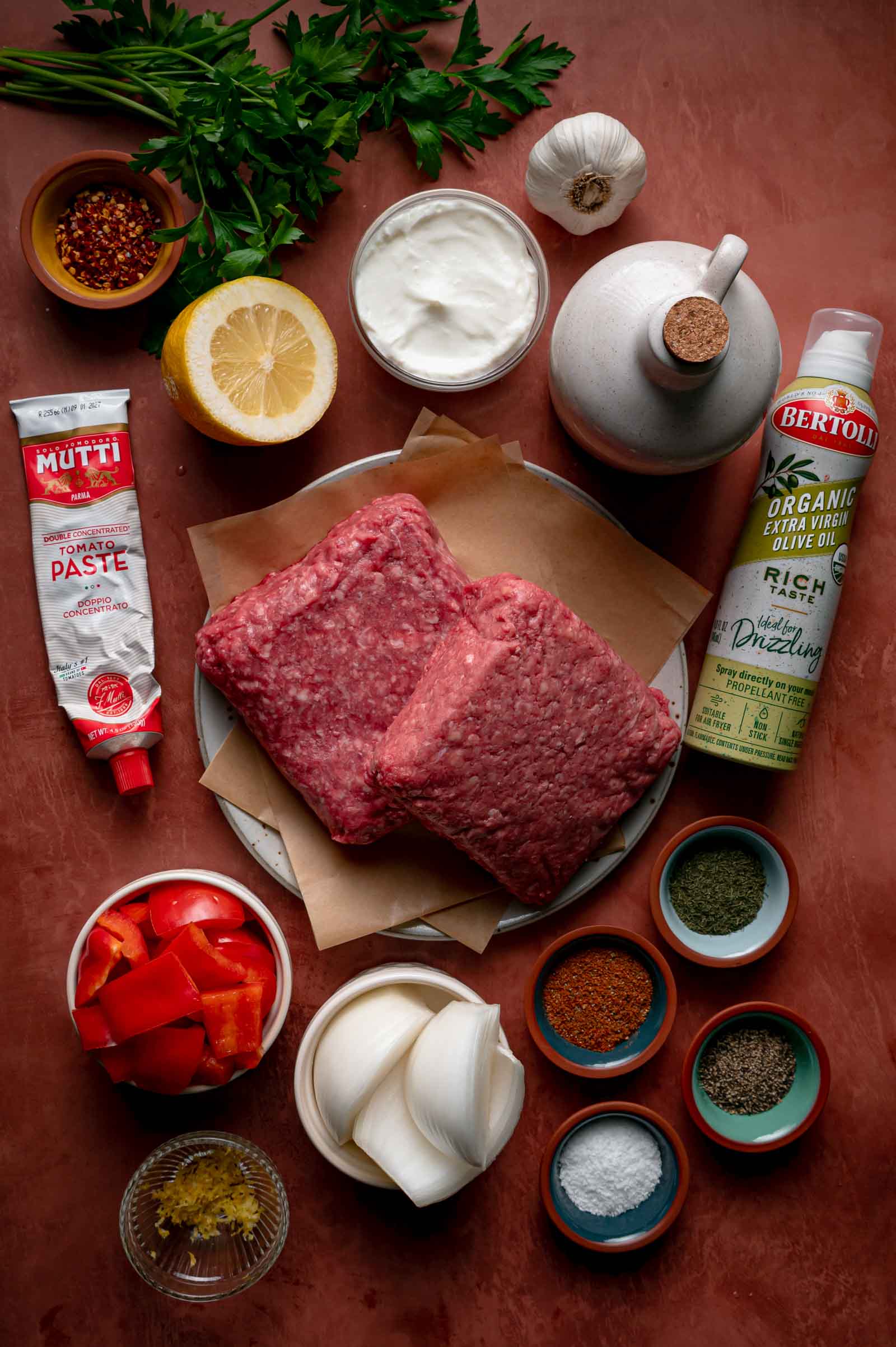
🔪 Ingredients for Sheet Pan Kebabs
For the Lemon Herb Yogurt Sauce
- Plain Greek yogurt, full-fat holds up best under the warm kebabs
- Fresh lemon juice and zest
- Extra virgin olive oil
- Fresh flat leaf parsley
- Dried dill, needs the fridge time below to soften; use fresh if you’re serving right away
- Kosher salt and black pepper
For the Kebabs
- Avocado oil or cooking spray, for the sheet pan
- Yellow onion, red bell pepper, fresh flat leaf parsley, and garlic cloves, pulsed together and drained hard; this step decides whether the meat holds its shape
- Ground lamb and ground beef (lean), equal parts; we’re using a combo of beef and lamb here but either work alone depending on what you have to use or prices at the market. We love the taste of American Lamb if you can find it because it lacks the ‘gamey’ flavor people often don’t like about lamb.
- Tomato paste
- Baharat seasoning, the backbone spice blend; look for one that leans warm (cinnamon, allspice, cumin) rather than straight chili-forward
- Aleppo pepper, fruity heat, milder than cayenne
- Kosher salt and black pepper
For Serving
- Pita breads or flatbreads, warmed
- Red onion
- Cucumber
- Tomatoes
Equipment
A food processor makes quick work of the aromatics; without one, hand-mince them and expect a slightly coarser texture. You’ll also want a clean kitchen towel or cheesecloth for draining, a large rimmed sheet pan, and an offset spatula or bench scraper for scoring and serving the strips.
📝 How to Make Sheet Pan Kebabs
- Make the yogurt sauce. Whisk the yogurt, lemon juice, zest, olive oil, parsley, dill, salt, and pepper until smooth. Chill it while the kebabs cook; the dried dill needs that time to soften and release its flavor.
- Heat the oven to 400°F. Coat a large rimmed sheet pan with a thin, even layer of avocado oil so the kebabs release clean after baking.
- Add the onion, bell pepper, parsley, and garlic to a food processor. Pulse in short bursts until finely chopped, not pureed. Over-processing turns the aromatics watery, so stop the second everything looks uniform.
- Drain the aromatics hard. Gather them in a clean kitchen towel or cheesecloth and squeeze over the sink until they feel damp but no longer drip. This is the step that keeps the meat from spreading or steaming later.
- Combine the drained aromatics with the lamb, beef, tomato paste, baharat, Aleppo pepper, salt, and pepper in a large bowl. Work it with your hands for about 2 minutes, until it feels slightly tacky and holds together when pressed. Stop mixing as soon as it does; overworking it makes the kebabs tough.
- Chill the meat mixture for 20 to 30 minutes, covered, in the fridge. This lets the fat re-solidify, which is what keeps the kebabs juicy once they hit the oven instead of losing all their fat to the pan.
- Press the chilled meat mixture into the center of the sheet pan, forming a roughly 9 by 12-inch rectangle. Keep the edges as thick as the center so they don’t dry out before the middle catches up.
- Score deep strips lengthwise and crosswise with an offset spatula or bench scraper, cutting almost all the way through. This is what turns one slab into individual kebabs, no skewers required.
- Bake for 15 minutes, until the edges are cooked through and just starting to brown on top.
- Switch the oven to broil. Broil for 3 to 5 minutes, watching the whole time, until the top is deeply browned. This is where the char happens, and it goes from good to burnt fast.
- Tilt the pan and spoon away any large pools of rendered fat, leaving a light coating of pan juices around the kebabs. Ground lamb and beef are safe to eat at 160°F internal; by this point the strips are typically well past that mark, but check with an instant-read thermometer if you want certainty.
- Rest the kebabs on the pan for 5 minutes, then separate the strips along the scored lines with your spatula.
- Serve hot with warm pita, red onion, cucumber, and tomatoes. Spoon the lemon herb yogurt sauce over the kebabs or serve it alongside.
🔄 Substitutions
- All ground lamb instead of the lamb-beef blend: richer, fattier result; drain the aromatics a beat longer since lamb renders more fat.
- All ground beef (lean) instead of lamb: milder flavor, same technique and timing.
- 1 tablespoon chopped fresh dill instead of dried in the yogurt sauce: skip the chilling step, since fresh dill doesn’t need time to rehydrate.
- No food processor: hand-mince the onion, pepper, parsley, and garlic, then drain the same way. The texture will be slightly coarser, but the method still works.
💡 Meat Nerd Tips
- What is Baharat? Also known as seven spices, baharat seasoning is a Middle Eastern spice blend built on allspice, cinnamon, cumin, coriander, and black pepper. It’s warm and a little sweet, not hot.
- Pale on top after baking? Give it another minute under the broiler, not more time in the oven. Extending the bake dries the meat out before it ever gets a charred finish.
- Watery aromatics ruin the texture. Short pulses only, and stop as soon as everything is finely chopped. A food processor left running for even a few extra seconds turns onion and pepper into a puree that makes the meat spread instead of holding its shape.
- Make the sauce a day ahead. The lemon herb yogurt sauce improves by day two, once the dried dill has fully bloomed. Store it separately from the kebabs so it doesn’t go thin.
- Want a bigger char surface? Score the strips slightly narrower than the recipe calls for; more edge means more broiler contact per bite.
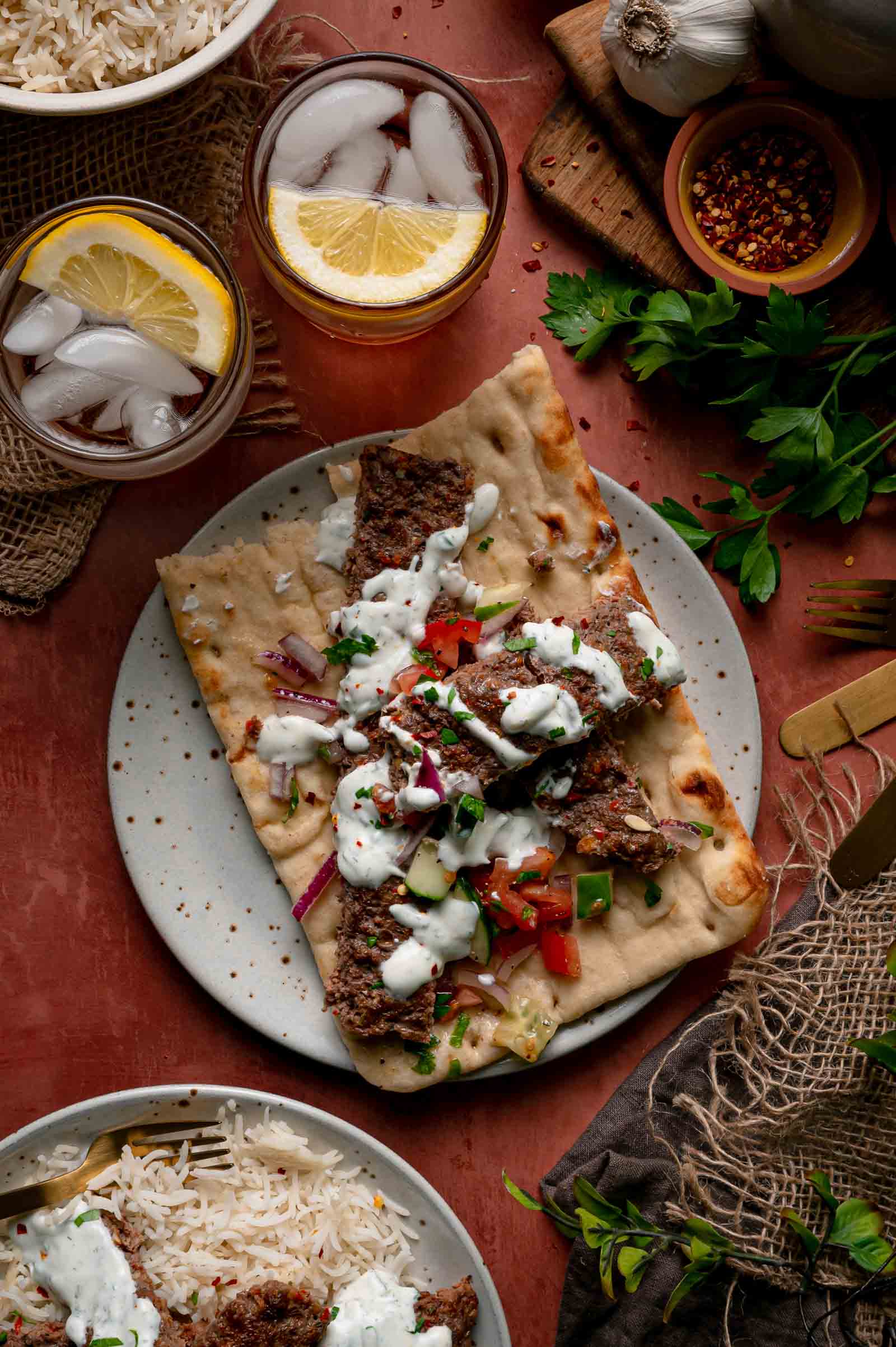
🍽️ What to Serve with Sheet Pan Kebabs
🧊 Leftovers and Storage
- Refrigerate cooked kebabs in an airtight container for up to 4 days.
- Store the lemon herb yogurt sauce separately in an airtight container for up to 4 days; stir before serving, since a little liquid collects on the surface.
- Reheat kebabs covered in a 300°F oven until warmed through, or sear them in a hot skillet for a minute per side to bring the edges back to crisp.
This recipe went viral for good reason and it’s the most fun we’ve had cooking all season. It skips the grill and the skewers but still gives you damned good kebabs that feed the whole family. The whole thing comes together on one sheet pan, with real char on every edge and a short chill that keeps every bite juicy.
Prevent your screen from going to sleep
-
Clean kitchen towel or cheesecloth
-
Large mixing bowl
-
Rimmed half sheet pan, 18×13-inch
-
Offset spatula or bench scraper (for pressing and scoring the meat)
For the Lemon Herb Yogurt Sauce
Make the Yogurt Sauce
-
Whisk the yogurt, lemon juice, zest, olive oil, parsley, dried dill, salt, and black pepper until smooth. Chill the sauce while the kebabs cook so the dried dill can soften and release its flavor.
Pulse the Aromatics
-
Add the onion, bell pepper, parsley, and garlic cloves to a food processor. Pulse in short bursts until finely chopped but not pureed.
Mix the Meat
-
Combine the drained aromatics with the lamb, beef, tomato paste, baharat, Aleppo pepper, salt, and black pepper in a large bowl. Mix for about 2 minutes with your hands, folding and pressing until the mixture feels slightly tacky and holds together when pressed.
Shape the Kebabs
-
Transfer the chilled meat mixture to the center of the sheet pan. Form a roughly 9 by 12-inch rectangle, pressing to an even thickness and smoothing the outer edges so they aren’t thinner than the center.
Broil
-
Switch the oven to broil. Broil for 3 to 5 minutes, watching continuously, until deeply browned. Internal temp should read at least 160°F.
Serve
-
Serve with warm pita or flatbread, red onion, cucumber, and tomatoes. Drizzle the lemon herb yogurt sauce over the kebabs or serve alongside.
- Refrigerate leftover kebabs up to 4 days; store sauce separately up to 4 days.
- Reheat covered at 300°F, or sear in a hot skillet to re-crisp the edges.
- Developed on a standard rimmed half sheet pan (18×13-inch).
- Ground lamb and beef are safe at 160°F internal temperature
- Baharat seasoning: a warm Middle Eastern spice blend of allspice, cinnamon, cumin, coriander, and black pepper. Not spicy despite the name, it’s the backbone flavor here and the perfect blend for the most authentic flavor in your home kitchen.
Serving: 1serving | Calories: 475kcal | Carbohydrates: 7g | Protein: 30g | Fat: 36g | Saturated Fat: 14g | Polyunsaturated Fat: 2g | Monounsaturated Fat: 16g | Trans Fat: 1g | Cholesterol: 111mg | Sodium: 1131mg | Potassium: 616mg | Fiber: 2g | Sugar: 4g | Vitamin A: 1554IU | Vitamin C: 43mg | Calcium: 90mg | Iron: 4mg
Quick Summary
Sheet pan kebabs take the flavor of skewered lamb kofta and get there without a grill: a spiced lamb and beef mixture pressed into one slab, scored into strips, baked, then broiled for char. Drain the aromatics hard and don’t skip the broil, and you’ll get kebab-shop results from your own oven in about 90 minutes, most of it hands-off chill time. If you’d rather thread it onto skewers, our Grilled Lamb Kofta uses the same spice base over live fire.
❓ FAQs
No. Deep scoring exposes enough of the sides for the edges to brown properly. The strips separate cleanly along those lines after cooking and resting.
Baharat is a warm Middle Eastern spice blend built on allspice, cinnamon, cumin, coriander, and black pepper. If you can’t find a jar, mix 1 teaspoon cumin, ½ teaspoon cinnamon, ½ teaspoon allspice, and ¼ teaspoon black pepper for a close stand-in.
Yes. Finely mince the onion, bell pepper, parsley, and garlic by hand, then drain them in a towel the same way. The finished texture will be slightly coarser, but the method and timing don’t change.
Ground beef and lamb are safe at 160°F internal. By the time the top is deeply browned under the broiler, the strips are typically well past that mark, but check a few spots with an instant-read thermometer if you want certainty.