



There are hundreds of air purifiers available in Singapore, ranging from compact personal units that fit on your desk to powerful systems capable of improving the air across multiple connected rooms. If you have been doing your research, you’ll have come across terms such as HEPA, CADR, ionisers and smart sensors; it can be difficult to know which features actually matter and which are simply marketing buzzwords. So, how do you choose an air purifier in Singapore?
After researching and testing air purifiers for rooms in my home as well as our office, I found that finding the right model becomes much easier when you break the process into a few practical considerations.
How to choose an air purifier in 7 easy steps
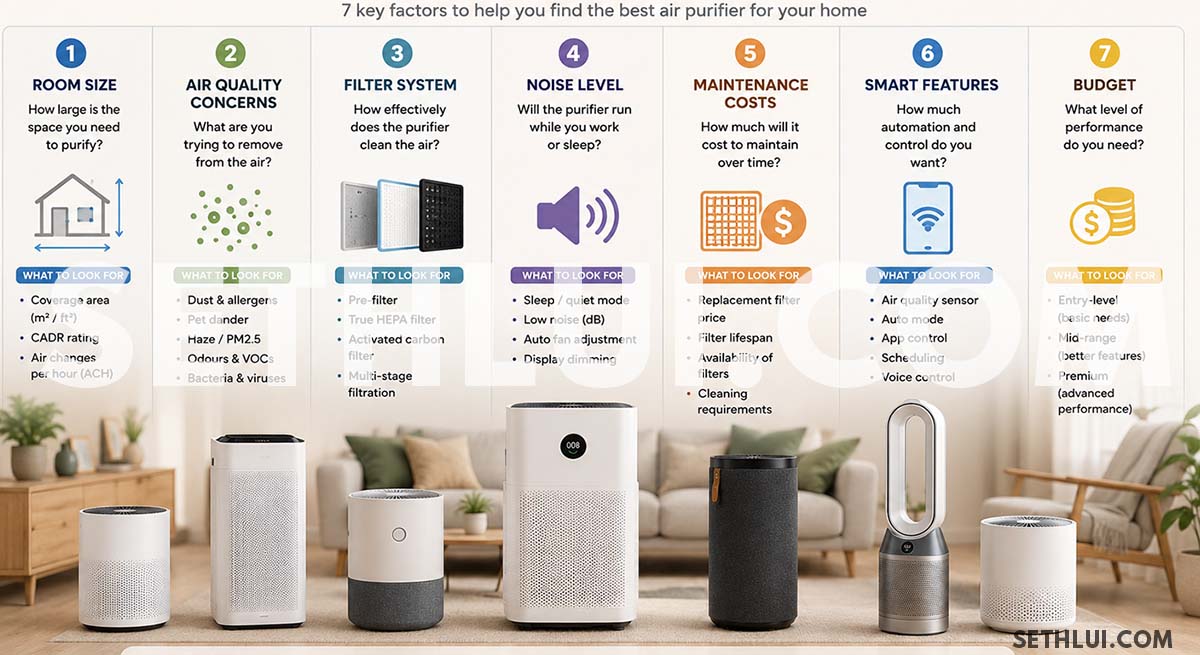
| Consideration | Key question | What to look for |
| Room size | How large is the space you need to purify? | Coverage area, CADR rating, recommended room size |
| Air quality concerns | What are you trying to remove from the air? | Dust, allergens, pet dander, haze particles, odours, VOC filtration |
| Filter system | How effectively does the purifier clean the air? | True HEPA filters, activated carbon filters, multi-stage filtration |
| Noise level | Will the purifier run while you work or sleep? | Sleep mode, low-noise operation, quiet fan settings |
| Maintenance costs | How much will ownership cost over time? | Replacement filter prices, filter lifespan, cleaning requirements |
| Smart features | How much automation do you want? | Air quality sensors, app control, automatic modes |
| Budget | What level of performance do you actually need? | Entry-level, mid-range or premium features |
You can download and keep this image to help you choose an air purifier for the typical Singapore home or office:
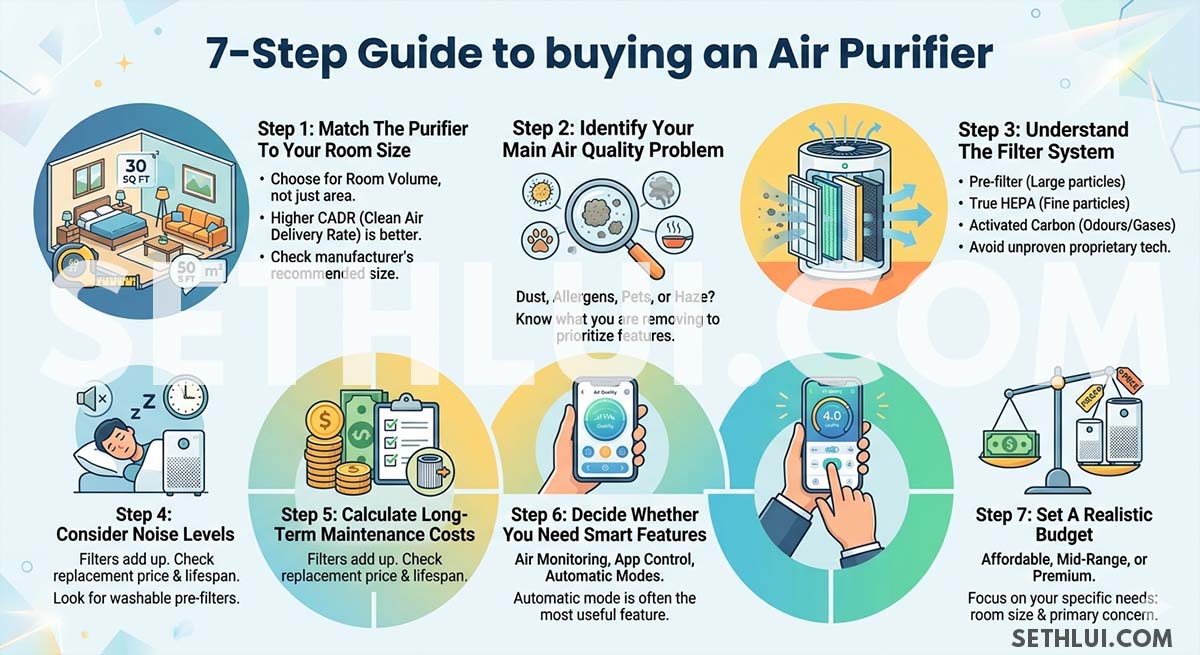
Step 1: Determine room size
One of the biggest mistakes people make is buying an air purifier that is too small for their room.

A compact unit may work perfectly in a bedroom but struggle to clean the air effectively in an open-plan living room. Manufacturers usually provide a recommended room size, but I prefer paying closer attention to the CADR (Clean Air Delivery Rate) figure. A higher CADR generally means the purifier can clean more air in less time.
As a rough guide, bedrooms typically require less purification power than living rooms, dining areas or large studio apartments.
If you’re deciding between two similarly priced models, choosing the one with slightly higher coverage often provides more flexibility in the future.
Step 2: Identify your air quality problem
Not everyone buys an air purifier for the same reason.

Some people are trying to reduce dust accumulation. Others suffer from allergies and want relief from airborne allergens. Pet owners may be looking to manage fur and dander, while families with young children often want additional protection during haze season.
Understanding your primary concern will help you prioritise the right features.
For example:
- Dust and allergens benefit from HEPA filtration.
- Pet owners should look for strong particle filtration and odour control.
- Smokers and cooking-heavy households should prioritise activated carbon filtration.
- Haze protection requires effective fine-particle filtration.
Knowing what you are trying to remove from the air makes it easier to narrow down your options.
Step 3: Understand the filter
Even the most ‘advanced’ purifier is only as effective as the filter inside it.
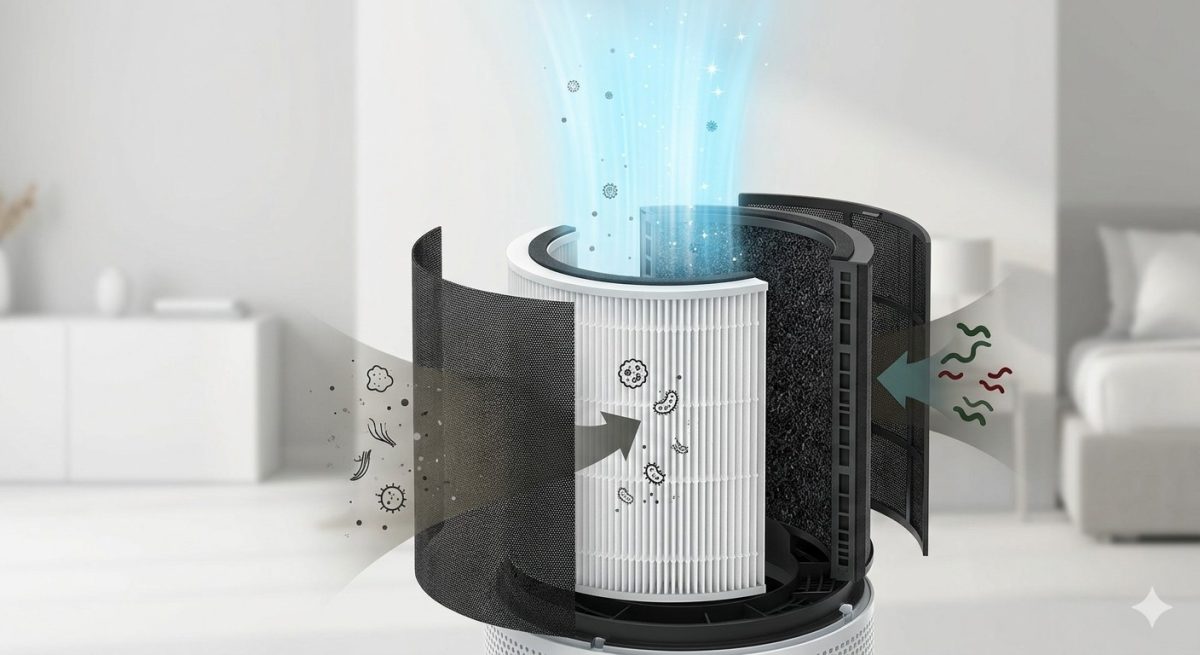
Many brands advertise sophisticated “air purification technology” but the filtration system remains the most important component. A good purifier should ideally include:
- Pre-filter for larger particles
- True HEPA filter for fine airborne particles
- Activated carbon filter for odours and gases
I generally avoid focusing too heavily on proprietary technologies and instead pay attention to the quality and availability (and cost – see Step 5) of replacement filters.
Step 4: Consider noise level
I discovered the hard way that not all air purifiers sound the same.

Some powerful models may be of the perfect capacity for your room but are surprisingly noisy at higher fan speeds. This may not matter in a living room with TV noise and chatter, but it becomes a major consideration in bedrooms, home offices and baby nurseries.
If you intend to run the purifier overnight, look for features such as:
- Sleep mode
- Automatic fan adjustment
- Low-noise operation
- Display dimming
I personally prioritise quiet operation because if I have to switch off a purifier because of the noise, it just becomes an expensive piece of decor.
Step 5: Calculate maintenance costs
Many buyers focus on the purchase price and forget about ongoing costs.
Most air purifiers require periodic filter replacements, and these costs can add up over the lifetime of the air purifier you choose. Some affordable purifiers become surprisingly expensive once replacement filters are factored in.
Before buying, check:
- Replacement filter pricing
- Expected filter lifespan
- Availability of replacement stock
- Other cleaning requirements
A slightly more expensive purifier may actually cost less over time if its filters last longer or are more affordable to replace.
Step 6: Do you need smart features?
Smart functionality has become increasingly common in modern air purifiers.
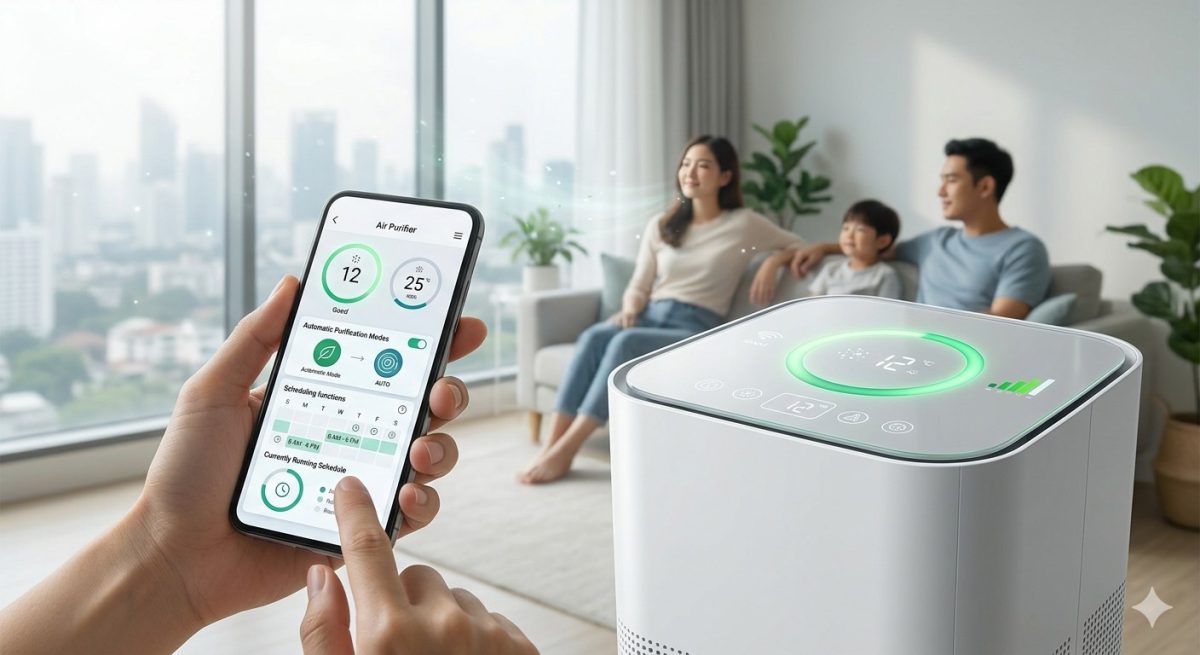
Some features that I have found useful include:
- Real-time air quality monitoring
- Smartphone app control
- Automatic purification modes
- Scheduling functions
I find automatic modes especially useful because they adjust fan speed based on detected air quality without requiring constant intervention. It’s ideal for nighttime use.
Of course, not everyone needs app control. If your goal is simply cleaner air, a well-performing purifier without smart features may offer better value — see step 7.
Step 7: Set a budget
Air purifiers are available across a broad range of prices.
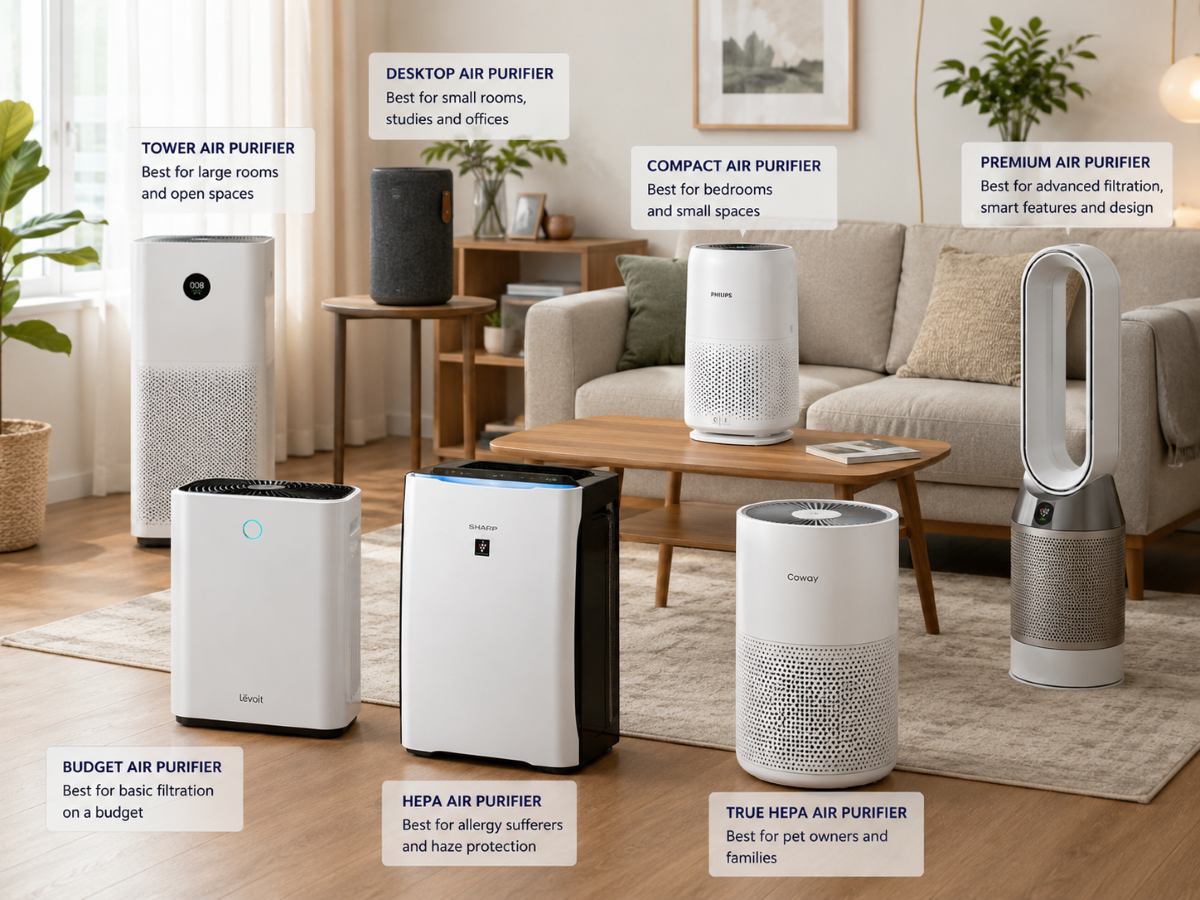
- Affordable models typically provide basic HEPA filtration and are suitable for smaller bedrooms or study rooms.
- Mid-range models often offer stronger CADR performance, larger coverage areas and better filter systems.
- Premium models usually include advanced sensors, sophisticated automation, quieter operation and superior build quality.
Rather than chasing the highest specifications or a fancy look, choose a purifier that covers your room size and addresses your specific air quality concerns.
How to choose an air purifier for your home or office
The right air purifier depends less on brand and more on matching the unit to your environment. Start with room size, as an undersized purifier will struggle to clean the air effectively regardless of its features. Next, identify your main concern, whether that’s dust, allergies, pet dander, cooking odours or haze particles, then prioritise the appropriate filtration system.
For bedrooms, nurseries and home offices, quiet operation and sleep modes can make a significant difference to day-to-day use. It’s also worth comparing replacement filter costs before buying, as these often determine long-term value more than the purchase price itself. Finally, decide whether features such as air quality sensors and app control are genuinely useful for your routine, then choose a model that meets your needs without paying for unnecessary extras.
Here is a list of the best air purifiers that we recommend.
The post How to choose an air purifier in Singapore in 7 easy steps [downloadable checklist inside] appeared first on SETHLUI.com.