



Seafood
Nova: Short for Nova Scotia, once a prime source of this deli favorite. Today, the name generally describes a mild cure and light cold smoke, rather than where the fish was caught. Don’t confuse it with traditional lox, which is salted, but not smoked. The latter takes its name from a word for salmon in Yiddish, with relatives in Scandinavian languages.
Hot-smoked salmon: Cured fish that is cooked as well as smoked. The flesh turns opaque and breaks into moist flakes. Kippered salmon belongs to this family; I’m partial to a dry cure that gives it a firm exterior and sweet-salty flavor.
Salmon candy: Strips or nuggets of cured salmon, smoked and repeatedly glazed with maple syrup or honey. Bronzed outside, flaky inside, and damn near irresistible. Some versions are dried further until chewy like jerky.

The Fish
Here are the salmon you need to know about for smoking:
King (chinook): My first choice when the budget permits—rich, buttery, and generously endowed with the fat that keeps smoked fish luscious. The drawback? The price. My local fish market sells it for $40 / pound!
Sockeye: Deep red flesh, a firm texture, and a forthright salmon flavor that stands up beautifully to smoke. Leaner than king (and not as luscious), so watch it closely to avoid drying it out.
Coho (silver): Milder and more delicate than sockeye, and often less expensive than king—a fine choice for kippered salmon or salmon candy. Its leaner flesh calls for a gentle heat.
Copper River: A place, not a species: Alaska’s Copper River produces king, sockeye, and coho. These fish store fat for a formidable upriver migration, making them prized for richness—and often priced accordingly.
The Source
When I was growing up, fresh salmon was a novelty and a luxury—a seasonal food you waited all year to enjoy. Today, farming makes it available year-round. Convenience has its advantages, but I still vote wild.
Wild Pacific salmon offers distinct species, firm flesh, and flavors worth seeking out. Fresh supplies generally peak from late spring through early fall, depending on the species and fishery; price and availability fluctuate. Good frozen wild salmon can be a better buy than tired “fresh” fish. Thaw it in the refrigerator.

Farmed Atlantic salmon offers consistent availability, plenty of fat, and usually a lower price. I find its texture softer and flavor less distinctive; environmental practices vary considerably by producer. Faroe Islands salmon is one option worth considering when wild isn’t available—ask who raised it and how. All “Atlantic” salmon sold commercially in the United States is farmed.
Fresh is best—but how do you recognize it? Look for glossy, moist flesh with no browning or dried edges; on whole fish, clear eyes and red gills. Ask to smell it. (Really.) It should smell clean and briny, not fishy or sour. A good fishmonger will understand. Your nose is a useful first check.
The Trim
Keep skin in the game: I generally leave it on for smoking. It supports the flesh and helps keep it from sticking to the rack.
Prefer skinless? Lay the fillet skin side down on a cutting board. Starting at the narrow tail end, slip a sharp filleting knife between skin and flesh. Grip the skin with a paper towel and pull it taut while working the blade toward the thick end, keeping it nearly flat against the board.

Bones be gone: Run your fingertips along the fillet to locate the pin bones. Lift the fish slightly from underneath to expose their tips, then pull them out with kitchen tweezers or clean needle-nose pliers, following the direction of the bones.
The Cure
Salt firms the flesh and draws out moisture; sugar rounds out the saltiness. Cure in a nonreactive dish in the refrigerator, never on the counter.
Dry cure: For my kippered salmon, mix 2 parts dark brown sugar with 1 part kosher or coarse sea salt by volume, plus freshly ground black pepper to taste. Spread some underneath the fish and pat the rest over it. Figure on about 4 hours for fillet sections. My Scandinavian-style cold-smoked salmon uses an all-salt cure; a whisky variation uses equal volumes of salt and sugar, with juniper and bay leaves. And of course scotch whisky or bourbon. Those thicker fillets cure for about 24 hours under the respective recipe’s directions.
Wet cure (brine): My salmon candy starts with 1 quart water, 1 cup brown sugar, 1/4 cup kosher or coarse sea salt, and 1/2 cup maple syrup. Stir until dissolved, chill, and immerse the strips for about 8 hours in the refrigerator.
These are flavor formulas, not interchangeable preservation treatments. Salt brands differ greatly in weight per cup; stick with the salt specified in your recipe, particularly for cold smoking.
After curing, rinse as directed, blot dry, and arrange the fish on a rack over a rimmed baking sheet. Dry uncovered in the refrigerator for 1 to 2 hours, or until tacky. That sticky surface—the pellicle—helps the smoke adhere. Don’t skip it.
The Smoke
The basic distinction: cold smoking flavors the fish without cooking it; hot smoking does both.
Cold Smoking
Use a dedicated cold smoker or an external smoke generator feeding an unlit grill or smoker. Keep the fish away from the smoke source and monitor the chamber temperature: typically 70 to 90 degrees F, without exceeding the limits of your tested process. Alternatively, place the fish on a rack over a large pan of ice and smoke on a charcoal grill or smoker (set on low heat).
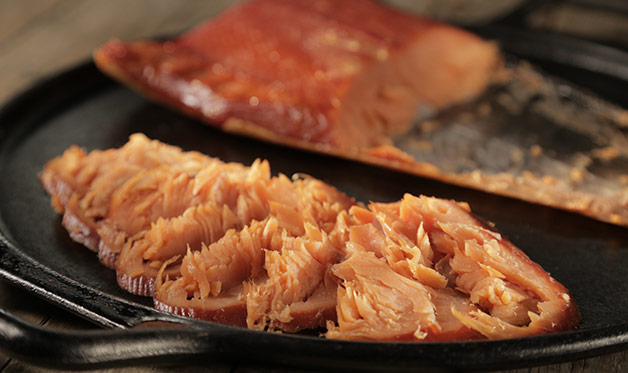
My Danish-style preparation takes 18 to 24 hours, followed by a rest in the refrigerator. The finished fish is bronzed, somewhat firm, and satiny inside.
Here’s the catch: cold smoking does not kill parasites or reliably eliminate harmful bacteria. Use a tested process with specified salt levels and temperature controls, and fish commercially frozen for parasite destruction when required. A pan of ice can help control heat; it does not make an improvised process safe. If you’re new to smoking fish, start with hot smoking.
Hot Smoking
Two options here. For “cool” hot smoking, set your smoker or grill to 225 degrees F. On a charcoal grill, bank a small fire on one side and place the salmon on the other, away from the coals. Oil the grate, lay the fish skin side down, and close the lid. Allow roughly 1 to 2 hours for a fillet, depending on thickness.
For “hot” hot smoking (good for kippered salmon), set your grill to 350 degrees. The cook time here is 20 to 30 minutes.

Salmon candy, cut into strips, takes about 45 to 60 minutes at 225 degrees. Start brushing it with maple syrup after 30 minutes, repeating once or twice as the glaze sets.
Times are guides. For all three hot-smoked preparations, check the thickest part with an instant-read thermometer: aim for 145 degrees F. The flesh should be opaque and separate into clean flakes. Candy should have a glossy, bronzed exterior; don’t sacrifice a moist center chasing a darker crust.
The Wood
Over the centuries, smoke-masters have developed specific preferences for wood. Alder is king in the Pacific Northwest. Hawaiians swear by kiawe (aka mesquite). Beech is the wood used at Danish smokehouses. Cherry and apple bring a mellow sweetness. Remember to dose the smoke gradually: this is one case where too much smoke really is too much smoke.
The Serve
For cold-smoked salmon, use a long, slender, very sharp knife to cut broad, paper-thin slices on the diagonal, leaving the skin behind.
Serve European-style with toast points or blinis, sour cream, capers, minced red onion, and chopped hard-cooked egg—the whites and yolks in separate little bowls. Add dill or parsley and lemon wedges. Or go Danish with an open-face rye bread sandwich.
Jewish deli-style? A toasted bagel, a generous schmear of cream cheese, smoked salmon, sliced onion, tomato, and capers. Sunday morning doesn’t get much better.
Serve hot-smoked or kippered salmon warm or chilled, in generous flakes; put salmon candy out with cocktails. Its sweet-salty swagger can stand up to the strongest spirits.
Refrigerate promptly at 40 degrees F or below and enjoy homemade hot-smoked salmon within 3 days, or freeze it. Follow your tested process’s storage limits for cold-smoked fish. Salmon candy may look like jerky, but this version still belongs in the refrigerator.
Finally, to make an amazing smoked salmon spread, puree equal parts smoked salmon and cream cheese in a food processor, adding plenty of black pepper. That’s another Raichlen favorite. I think I’ll have some right now!