



Back to Barbecue Basics
Thanksgiving is fast approaching, which means millions of Americans are preparing to wrestle with the largest bird we’re likely to encounter all year.
And turkey presents a singular challenge. The breast, which accounts for most of the meat, is notoriously prone to drying out. The legs and thighs need more heat to become tender. And the skin? You want it crisp and golden brown, not pale and rubbery.
Small wonder so many Thanksgiving turkeys arrive at the table accompanied by a gravy boat large enough to float a battleship.
Fortunately, the solution already stands in your backyard.
We’re talking about your grill.
Over the years, I have prepared Thanksgiving turkey just about every way imaginable. I’ve marinated it Miami-Cuban style, seasoned turkey breasts like pastrami, stuffed truffles and butter beneath the skin, and grilled birds on rotisseries, beer cans, and charcoal kettles.
I’ve even experimented with borrowing techniques from deep-frying to make the skin crisper.

But there’s one method I keep returning to: smoke-roasting.
It’s a marriage of indirect grilling and smoking, conducted at a higher temperature than traditional barbecue. The result is a turkey with the aromatic character of smoked meat, the juicy breast of a properly brined bird, and the handsome bronze skin you’d expect from a Thanksgiving centerpiece.
And, as an added dividend, your oven remains available for the stuffing, sweet potatoes, and pies.
Here’s what we’ve learned from years of Thanksgiving grilling at BarbecueBible.com.
First, Buy the Right Bird
In the world of Thanksgiving turkeys, bigger is not necessarily better.
My bird of choice is an organic turkey weighing approximately 12 to 14 pounds. Buy it from a local farm when possible. If not, search out old-timey heritage breeds—remarkable for their flavor, even if they don’t boast the enormous breasts of their supermarket counterparts. As always, buy organic when you can find it.
Those mammoth 20- to 25-pound birds? Leave them for someone else.
If you need that much meat, cook two smaller birds instead. A smaller turkey is easier to maneuver, easier to grill evenly, and considerably less likely to emerge with overcooked breast meat and underdone thighs.

Figure on about a pound of turkey per person, more if you want an ample supply of leftovers for sandwiches.
Fresh turkey is ideal, but frozen is perfectly acceptable—provided you allow enough time to thaw it. Plan on approximately one day in the refrigerator for every four to five pounds. Thus, a 12-pound bird will need roughly three days.
Forgot to thaw the bird? You can use the cold-water method: Keep it in leakproof packaging, submerge it in cold water, and change the water every 30 minutes. Figure on about 30 minutes per pound and grill it immediately afterward.
One additional warning: Many mass-market turkeys come pre-injected with salt solutions. Read the label. If yours has already been enhanced, additional brining may leave you with turkey that tastes more like a salt lick than Thanksgiving dinner.
For more buying advice, see my How to Grill the Perfect Thanksgiving Turkey: A First-Timer’s Guide.
To Brine or Not to Brine?
Yes, and the turkey anatomy is the culprit. The breast is lean and naturally less forgiving than the thighs and drumsticks. Ideally, the breast reaches a safe internal temperature of 165°F while the dark meat benefits from being taken somewhat higher.
That’s a difficult balancing act when everything is attached to the same bird.
Brining helps. Salt changes the structure of the muscle proteins, improving their ability to retain moisture during grilling. Add sugar, herbs, citrus peel, and spices, and you’re also building flavor.

My personal favorite is a bourbon brown sugar brine. I like bourbon for its sweet, woodsy character—a natural partner for smoke-roasting, given that bourbon spends its formative years in charred oak barrels.
To this I like to add aromatics, such as lemon zest, cloves, and bay leaves.
Of course, not everyone wants to devote a substantial portion of the refrigerator to a turkey floating in a vat of saltwater.
There are alternatives.
Wet Brining, Dry Brining, and Injecting
Wet brining means soaking the bird in seasoned saltwater, generally for 24 hours. It produces moist, well-seasoned meat, but requires space and pre-planning. Keep the turkey and brine at or below 40°F throughout.
Dry brining involves seasoning the bird with salt and sometimes spices, then refrigerating it uncovered. You eliminate the bucket of liquid, and the refrigerator air helps dry the skin. That’s a considerable advantage if crispy skin is your objective.

Then there’s injecting, a technique we explore in our blog Battle of the Birds: Brining vs. Injecting.
Injecting involves using an oversized syringe to deliver flavored liquids—melted butter, broth, bourbon, or other seasonings—directly into the meat.
It’s faster than brining, and you get to perform a little amateur poultry surgery in the process.
The downside is that injected liquids don’t always distribute evenly. You may wind up with a very flavorful patch of breast meat alongside another that’s comparatively bland. You can also produce some impressive spurts of liquid from the injection holes.
Here at Barbecuebible.com we’ve used both techniques successfully. Which is better? It depends on your schedule, available refrigerator space, and desired result.
If you’re new to smoking turkey, we’d start with a good wet or dry brine rather than trying to master every technique simultaneously.
And remember that the salt concentration matters. Follow a tested brine recipe.
For a firsthand account of the process, see The Road to Tender Smoked Turkey: Brine and Spice with Confidence, one of our most popular Thanksgiving articles.
The Difference Between Smoking and Smoke-Roasting
Here we come to one of my strongest convictions about Thanksgiving turkey.
Smoking and smoke-roasting are not the same thing.
Traditional barbecue often calls for temperatures around 225 to 250°F. That’s admirable for a pork shoulder or beef brisket. It can also produce flavorful turkey meat.
But turkey has skin, and at those low temperatures, the skin often emerges soft and rubbery.
Our solution is smoke-roasting at approximately 325 to 350°F. You still get the flavor of burning hardwood, but the higher heat promotes browning and helps crisp the skin.
Think of it as roasting your turkey in a wood-fired oven—except the oven is your grill.
You can use a charcoal kettle, kamado, pellet grill, or gas grill. I often favor a kamado, such as a Big Green Egg or Primo, for its heat retention and temperature control. But I’ve produced excellent turkeys on ordinary kettle grills as well.
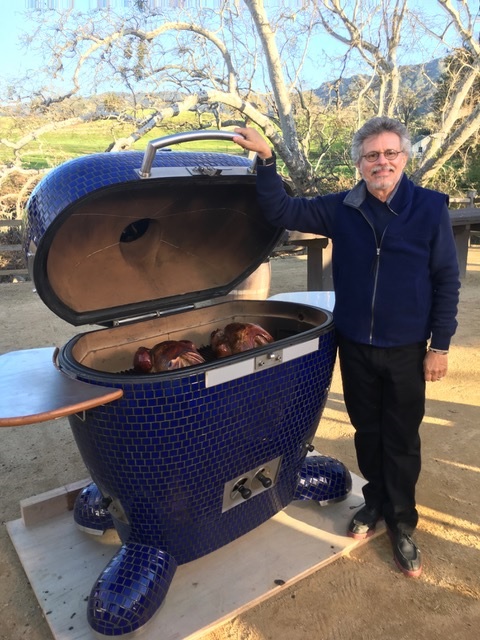
In other words, you don’t need an expensive new smoker to get started.
What Wood Should You Use?
Turkey readily absorbs wood smoke, and this is one instance when restraint pays dividends.
My woods of choice are oak or hickory. Both deliver a resolute smoke flavor, but without being overpowering. Other good options include apple, cherry, and pecan.
Mesquite has strong flavor—perhaps too strong for turkey (although plenty of people—including Texas) like it.
Add wood as needed to deliver a clean, pale blue stream of smoke. But don’t overdo it: Too much smoke can make the meat unpleasantly bitter.
Start with a few chunks of hardwood or a modest quantity of chips. Let the turkey taste like turkey.
How Long Does It Take to Smoke a Turkey?
Now for the question everyone asks, usually while looking anxiously at the clock.
Unfortunately, there isn’t a single reliable answer.
The size of the bird matters, of course, but so do the temperature of your grill, the temperature of the turkey when it goes on, the weather, and how often someone decides to lift the lid to admire the progress.

A 10- to 12-pound turkey smoke-roasted at around 350°F may take roughly 2 1/2 hours, as described in our Smoke-Roasted Turkey for Beginners guide. That’s an estimate, not a promise.
A large bird or a smoker running at 225°F will take considerably longer.
What matters is internal temperature.
Use a good instant-read thermometer, or better yet, a leave-in probe that allows you to monitor the turkey without opening the grill.
Check the thickest part of the breast and the innermost parts of the thighs and wings, avoiding bones. All must reach at least 165°F for food safety. Dark meat often benefits from reaching 175 to 180°F for additional tenderness.
Don’t let the clock dictate when you serve the bird. Let the thermometer decide.
How to Smoke-Roast Your Thanksgiving Turkey
The process is surprisingly straightforward. Most of the work happens before the turkey reaches the grill.
1. Dry the Bird
If you’ve wet-brined your turkey, remove it from the brine, discard the liquid, and dry the skin thoroughly with paper towels.
Then, if your schedule permits, place it on a wire rack over a rimmed baking sheet and refrigerate it uncovered for several hours or overnight.
Why? Because wet skin is the enemy of crisp skin. Excess surface moisture must evaporate before the skin can brown properly.
This is a particularly useful piece of advice from Nancy Loseke’s Back to Basics: How to Smoke-Roast Your Thanksgiving Turkey.
2. Bring on the Butter
I learned this technique at the La Varenne cooking school in Paris many years ago.
The French didn’t have much use for American-style wood smoke, but they certainly understood butter.
The technique involves carefully loosening the skin over the turkey breast and spreading softened herb butter between the skin and the meat. As the bird roasts, the butter melts, enriching the breast and carrying the flavors of the herbs into the meat.
An even more elaborate version calls for cognac and, on particularly extravagant occasions, thinly sliced fresh black truffles.
Fortunately, you don’t need truffles to make this work.
Try softened butter mixed with chopped sage, thyme, rosemary, and parsley. Carefully work it beneath the skin without tearing it, then rub additional butter over the outside.
For the complete story, see Our Best Thanksgiving Turkey Yet: Butter Under the Skin.
3. Set Up Your Grill for Indirect Heat
Indirect grilling is essential. You’re roasting a whole turkey, not searing a steak.
On a charcoal kettle, arrange the coals on opposite sides of the grill with a drip pan in the center. The turkey goes on the grate over the drip pan, not directly over the coals.
On a gas grill, leave the burner beneath the turkey unlit and use the surrounding burners to maintain the temperature.
On a kamado, install the heat deflector. On a pellet grill, set the controller to the desired temperature.
Aim for approximately 325 to 350°F.
Add your smoking wood, close the lid, and allow the grill temperature to stabilize.
One practical consideration: Make sure the turkey actually fits beneath the lid. In Nancy’s original smoke-roasting article, she recounts using a rotisserie collar on her Weber kettle to gain the extra height she needed.
Better to discover that problem before the charcoal is blazing.
4. Smoke-Roast the Turkey
Place the bird breast side up in the center of the grill, away from direct heat.
Close the lid and let the grill do its work.
Monitor the temperature and add fuel as necessary. Resist the temptation to open the grill every few minutes. You’re letting heat escape each time, and Thanksgiving dinner isn’t going to get here any faster.
If the breast begins to brown too quickly, shield it loosely with aluminum foil.
You can baste the turkey with melted butter as I do in some of his recipes, but don’t become a slave to the basting brush. Maintaining a consistent grill temperature and monitoring internal doneness are more important.
5. Check for Doneness
As the turkey approaches its estimated finishing time, check the internal temperature.
The breast, innermost thigh, and innermost wing should all register at least 165°F.
If the breast has reached temperature but the thighs need more time, shield the breast with foil and continue grilling.
Do not rely on the color of the skin, the position of a pop-up timer, or the clarity of the juices. A reliable thermometer is the final authority.
6. Rest Before Carving
Transfer the finished turkey to a large platter or cutting board and let it rest for approximately 20 to 30 minutes.
Don’t wrap it tightly in foil. Trapped steam will undo your efforts to crisp the skin.
Carve the turkey by removing the legs and thighs at their joints, separating the drumsticks, and slicing the thigh meat. Remove each breast half from the breastbone, then slice crosswise so everyone receives some of that handsome browned skin.
The Great Crispy-Skin Debate
For many people, turkey is judged by two things: juicy white meat and crackling crisp skin.
Unfortunately, the techniques that favor one don’t always favor the other.
Brining improves moisture retention but leaves the skin damp. Low-temperature smoking infuses flavor but doesn’t promote crispness. Wrapping the finished bird keeps it warm but traps steam.
This is why we favor smoke-roasting.
It also explains why we keep experimenting.
In our 2025 Thanksgiving turkey article, we propose a novel finishing technique borrowed from deep-fried turkey: carefully ladling hot oil over the finished bird to crisp the skin.
That’s an advanced technique involving dangerously hot oil, not something we’d suggest to a first-time turkey griller.
For most of us, the more practical approach remains thoroughly drying the skin before grilling and maintaining sufficient heat during smoke-roasting.
A final blast of higher heat may help with browning, provided the turkey hasn’t already reached its finished internal temperature.
A Few More Things We Feel Strongly About
Don’t stuff the turkey. Bread stuffing develops a far better crust when baked in a separate dish. Inside the turkey, it can become soggy and complicate the roasting process. Put a few onions, citrus halves, or herbs in the cavity if you like, but save the bread stuffing for its own pan.
Don’t buy the biggest bird in the store. We’ve already discussed our preference for smaller turkeys. It’s worth repeating, because size is one of the easiest mistakes to avoid.
Don’t overdo the smoke. Turkey needs seasoning and restraint, not the smoke treatment you’d give a whole beef brisket.
And don’t expect me to spatchcock my Thanksgiving turkey. Removing the backbone and flattening the bird is an effective technique for faster, more even grilling. But it looks like the bird got run over by a steamroller. Your turkey should be your Thanksgiving centerpiece—plump and round and bronzed with wood smoke. A bird worthy of a Norman Rockwell painting.
More of My Thanksgiving Turkey Recipes
One benefit of writing more than 4,000 recipes is that you have plenty of choices when Thanksgiving rolls around.
We’ve never been content with a single way to prepare turkey. Here are five recipes that demonstrate just how versatile smoke-roasting can be.
So there you have it. A manageable bird. A good brine. A modest amount of wood smoke. Indirect heat. And a thermometer you trust.
Thanksgiving turkey has a reputation for being difficult, but much of that reputation comes from trying to force one enormous bird to behave like several different cuts of meat.
My solution has always been to make the grill work for you.
And if you happen to have a little bourbon left over from the brine, well, we’re sure you can find a use for it.
Plan your next cook with our full recipe collection—weeknight grills, weekend projects, and special-occasion feasts.
Get Steven’s weekly grilling tips, seasonal recipes, and live-fire ideas in your inbox. Join our Up in Smoke newsletter. Sign up and get a FREE PDF of Steven Raichlen’s Best Ribs Recipes Ebook.
Preorder Man On Fire — A Steven Raichlen Memoir. And get some really cool rewards!
Looking to upgrade your tailgating setup? Check out our Tailgating Essentials.