



This is one of those meals you make when you don’t want to think. Marinate the pork, thread the skewers, and get the grill hot. No side quest, no fourth grocery run for one missing ingredient, or complicated ingredient list. Whip up a quick side dish while the pork is on the grill, and dinner’s on the table before you’ve had the chance to overcomplicate it. The only real planning required: remembering to make the lemon aioli ahead of time. We always want it. We always forget until the pork’s already skewered.
Pork has a problem on the grill. Pull it too soon, and the middle won’t be cooked. Get impatient and walk away, and they turn tough. Pork loin is lean, and the trick is to rotate it and not be shy about it, so it cooks evenly. Turn them every minute or so once they’re over direct heat, and you get tender bites all the way through instead of the chewy ones that make people swear pork tastes like shoe leather.
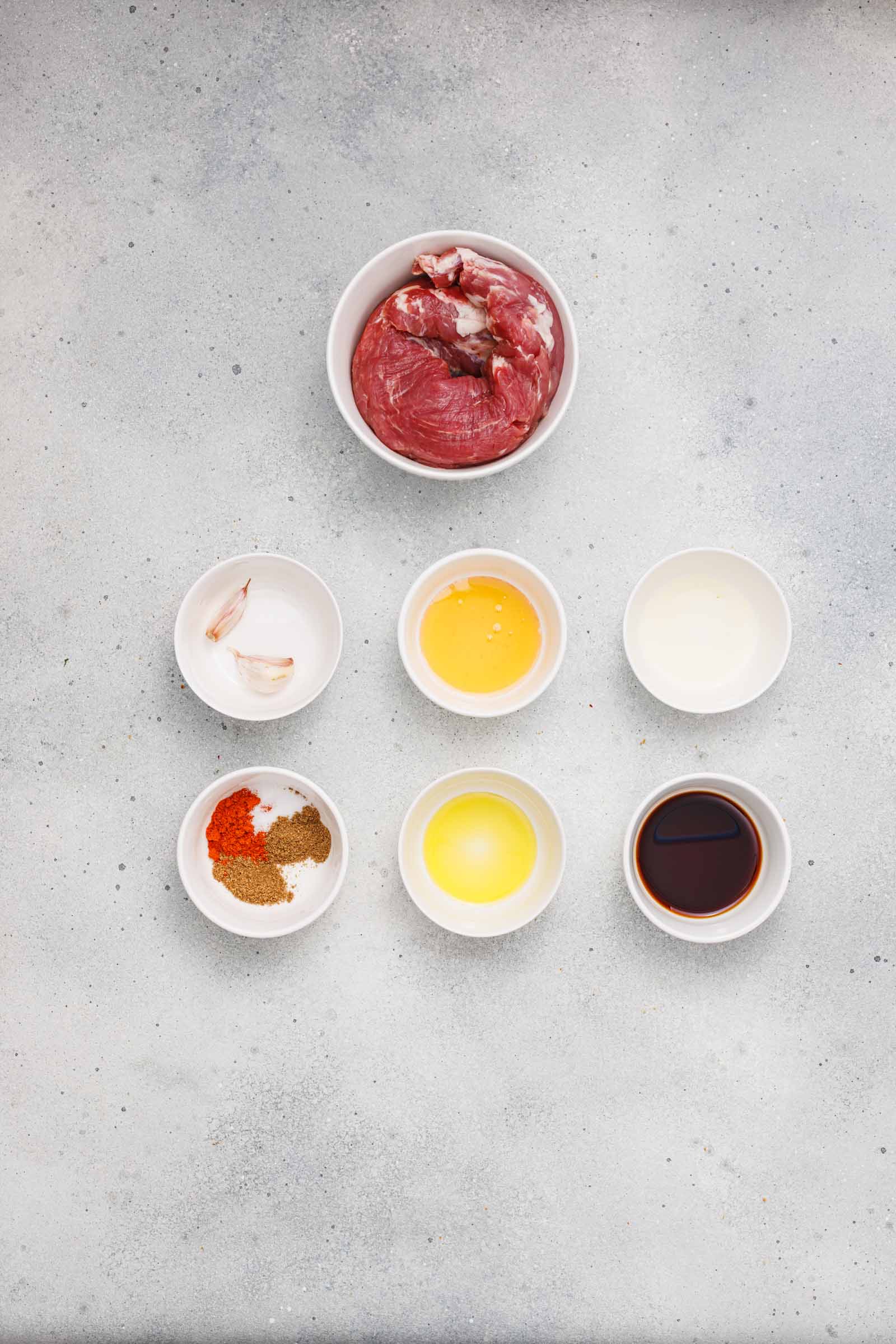
🔪 Ingredients for Grilled Pork Skewers
- Boneless pork loin: cubed to about 1 to 1.5 inches so every piece cooks at the same rate. Trim large sections of silver skin; a little surface fat is fine and helps with browning.
- Olive oil and soy sauce
- Fresh lemon juice
- Honey
- Garlic
- Smoked paprika
- Fresh oregano
- Black pepper
Equipment
- Instant read thermometer: non-negotiable here. Pork loin has zero fat margin for error, and it is the one tool most kabob recipes skip that decides whether skewers come out juicy or dry.
- Skewers: metal and reusable, or wooden and soaked in water for 30 minutes so they do not torch over direct heat.
- Small saucepan: for reducing the reserved marinade into a basting glaze.
📝 How to Make Grilled Pork Skewers
- Make the marinade. Whisk olive oil, soy sauce, lemon juice, honey, garlic, smoked paprika, oregano, and black pepper in a bowl until combined.
- Reserve the glaze portion. Set aside about a third of the marinade before it comes into contact with raw pork. This becomes your basting glaze later, and once raw meat sits in the rest, that portion is off limits for anything but the trash.
- Marinate the pork. Add the cubed pork loin to the remaining marinade, toss to coat, cover, and refrigerate for at least 1 hour or up to overnight. Loin does not need days to pick up flavor since it is not fighting through connective tissue the way a pork shoulder does.
- Reduce the glaze. While the pork marinates, simmer the reserved marinade in a small saucepan over medium-low heat for 5 to 7 minutes, until it thickens enough to coat the back of a spoon. Set aside off heat.
- Soak the skewers. If using wooden skewers, soak them in water for 30 minutes.
- Thread the skewers. Thread the marinated pork onto the skewers, leaving a little space between cubes so heat reaches all sides evenly.
- Set up a two-zone fire. Preheat the grill with one side on direct medium-high heat and one side on indirect medium heat.
- Sear, then finish. Grill the skewers over direct heat for 2 to 3 minutes per side to build color, then move them to the indirect side and continue cooking, turning occasionally, until an instant read thermometer reads 145°F in the thickest cube.
- Glaze and rest. Brush the reduced marinade over the skewers in the last 1 to 2 minutes of cooking for color and shine, then pull and rest for 3 minutes before serving. Carryover raises the temperature a few more degrees and keeps the juice in the meat rather than on the cutting board.
🔄 Substitutions
- Pork tenderloin instead of pork loin: works, but tenderloin is leaner still and cooks faster. Start checking the temp around the 8-minute mark instead of waiting for the full grill time.
- Dried oregano instead of fresh: use about a third of the volume; dried herbs are more concentrated, added with the other marinade ingredients rather than at the end.
- Tamari, instead of soy sauce: works identically for anyone avoiding gluten, with the same salt level.
- Lime juice instead of lemon juice: works, shifts the flavor slightly more tart. Use the same amount.
💡 Meat Nerd Tips
- Cube uniformly. Aim for pieces within a quarter inch of each other in size. Uneven cubes mean some hit 145°F while others are still raw in the center, and there is no fixing that once they are threaded onto the same skewer.
- Do not skip reducing the reserved marinade. Brushing raw marinade back onto cooked meat is a food safety risk. Reduce it at a full simmer first, and it does real work as a glaze instead of getting poured down the drain.
- Pull at 145°F, not before. Pork loin has no fat cushion to bail you out if you undercook or overcook it. The USDA safe temp for whole cuts is 145°F with a 3 minute rest.
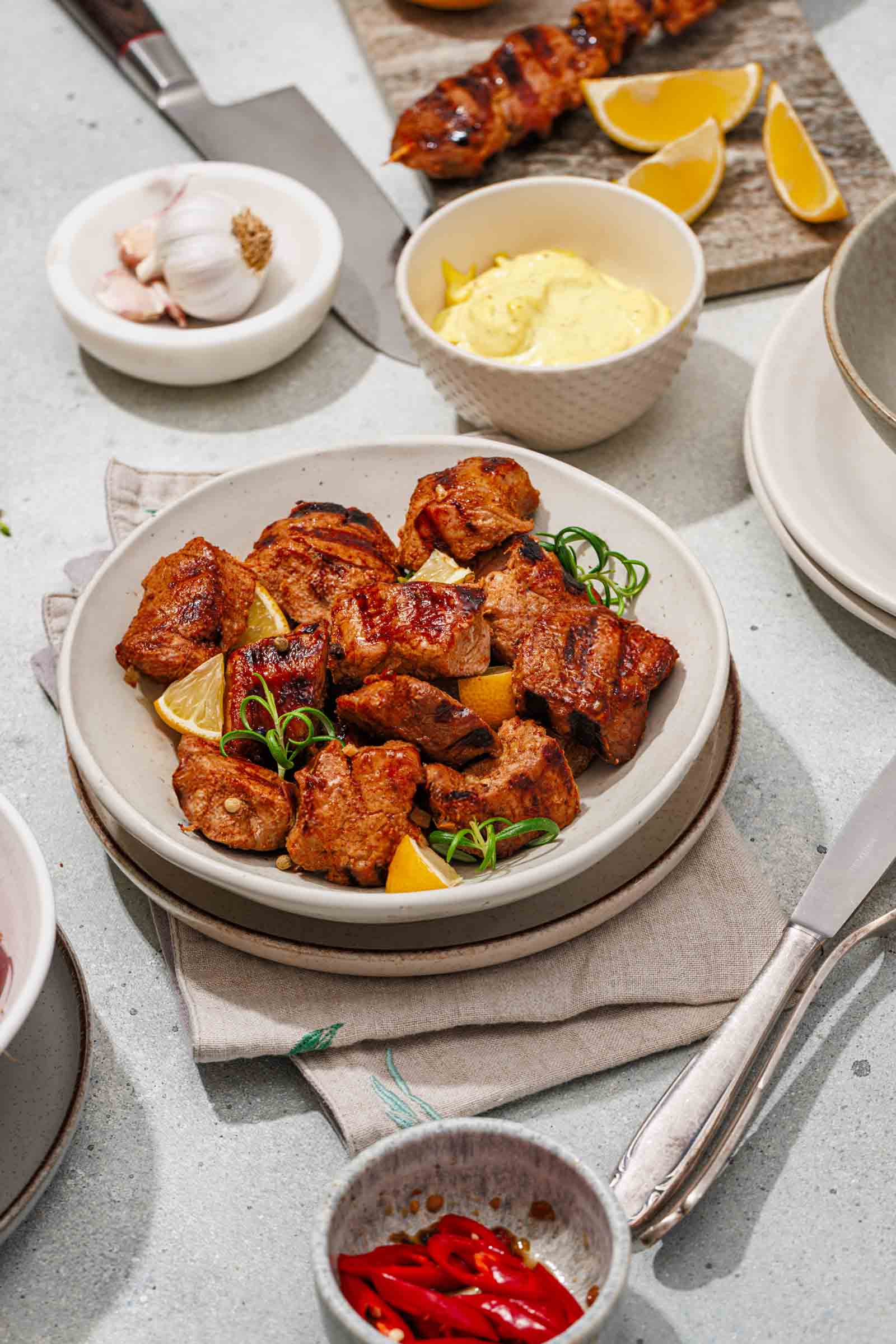
🍽️ What to Serve with Grilled Pork Skewers
- Something cool and bright: our Lemon Aioli cuts right through the char.
- Grilled vegetables or a quick rice pilaf to round out the plate.
- More off the same fire: our Grilled Pork Chops use the same two-zone method if you want to double up on pork for the table.
🧊 Leftovers and Storage
- Refrigerator: store cooled pork in an airtight container for up to 3 to 4 days.
- Freezer: pull the pork off the skewers and freeze in a freezer bag for up to 2 months. Thaw overnight in the fridge before reheating.
- Reheat: a hot skillet for 2 to 3 minutes, turning occasionally, brings back some char without drying it out further. The microwave works in a pinch, but expect a softer texture since there is no fat left to protect it.
No dry ends, no chewy bites, just pork that stays juicy from the first skewer to the last. The glaze goes on hot and sticky right at the end, giving you the kind of char and flavor that gets people asking what you did differently this time.
Prevent your screen from going to sleep
-
Skewers metal, or wooden soaked 30 minutes
-
Small saucepan
-
grill set up for two-zone heat: direct and indirect
Make the Marinade
-
Whisk olive oil, soy sauce, lemon juice, honey, garlic, smoked paprika, oregano, and black pepper in a bowl until combined.
Reserve the Glaze Portion
Marinate the Pork
-
Add the cubed pork loin to the remaining marinade, toss to coat, cover, and refrigerate for at least 1 hour or up to overnight.
Sear and Finish
-
Grill the skewers over direct heat for 2-3 minutes per side to build color, then move to indirect heat and continue cooking, turning occasionally, until an instant-read thermometer reads 145°F in the thickest cube.
- Pull temp is 145°F with a 3-minute rest. Only brush the reduced/simmered glaze onto cooked meat, never the raw marinade.
- Store leftovers in the fridge for up to 3-4 days, or freeze for up to 2 months.
- Serve with our Lemon Aioli as the perfect dipping sauce
Serving: 1serving | Calories: 241kcal | Carbohydrates: 7g | Protein: 27g | Fat: 12g | Saturated Fat: 2g | Polyunsaturated Fat: 1g | Monounsaturated Fat: 7g | Cholesterol: 71mg | Sodium: 560mg | Potassium: 486mg | Fiber: 1g | Sugar: 5g | Vitamin A: 269IU | Vitamin C: 2mg | Calcium: 33mg | Iron: 2mg
Quick Summary
Grilled pork skewers come down to one cut decision and one number: pork loin instead of shoulder or tenderloin, pulled at 145°F instead of eyeballing color. Reserve part of the marinade before the raw pork touches it, reduce it into a glaze, and brush it on in the last couple of minutes for the char and shine that a plain marinade soak cannot give you on its own. For more grilling technique, our Grilling Recipes collection and our marinade roundup cover the rest of the fire.
❓ FAQs
Pull them at 145°F on an instant read thermometer, then rest for 3 minutes. That is the USDA safe temp for whole cuts of pork, and it is also the temperature that keeps a lean cut like loin from drying out.
Yes. Tenderloin works, but it is leaner and cooks faster than loin. Start checking the internal temp around the 8 minute mark instead of waiting for the full grill time.
Dry usually means the pork went past 145°F before it came off the grill. Chewy usually means the cut was wrong: shoulder needs low, slow heat to break down its connective tissue, and a quick skewer cook never gives it time to do that.
At least 1 hour, up to overnight. Pork loin does not need days in a marinade the way tougher cuts do, since it is already tender and the marinade’s job here is flavor and moisture, not breaking down connective tissue.