


When you bring a dog into your life, you want them to be happy, balanced and able to handle the world with some degree of ease. Socialization plays a central role in that, giving your dog the tools to navigate life without fear. It’s about exposure, confidence, emotional regulation and learning how to exist calmly in a world full of unpredictability.
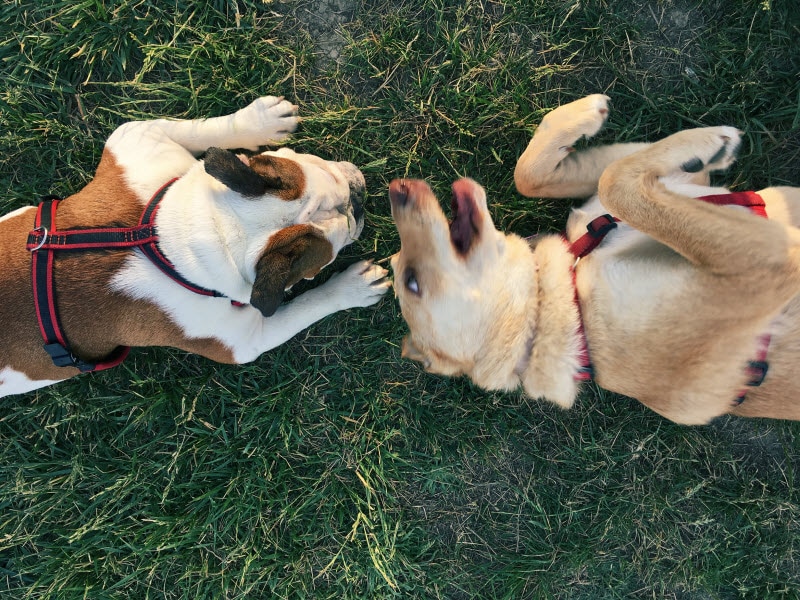
Yet socialization tends to be underrated amongst your dog’s hierarchy of needs, with nutrition, exercise, healthcare and boundaries tending to take precedence. But if you neglect the social component of your dog’s life, the consequences can show up in subtle ways, such as hesitation in new environments or overreacting to otherwise normal situations. The lack of socialization can also show up in more problematic ways, such as disruptive behaviors like separation anxiety.
Why animals play in the first place
It helps to understand that play is not frivolous. Researchers have studied animal play for decades and while there’s no single explanation that fits every species or behavior, the consensus is clear. Play supports:
- Social development
- Physical coordination
- Emotional regulation
- Cognitive flexibility
For dogs, play helps individuals learn boundaries, practice communication and adapt to stress. It’s how they test limits safely and learn how to read others. Play is one of the primary ways dogs develop social fluency. This matters because play is often the first thing restricted when people worry about “bad behavior.” But limiting healthy play can actually make behavior worse, not better.
Socialization can make your dog more stable
Socialization means gradually exposing your dog to a wide range of experiences: people, dogs, environments, sounds, surfaces, routines. It teaches them that novelty isn’t a threat. It’s much more than simply cultivating prosocial behavior and being “friendly.” A well-socialized dog is more likely to:
- Remain calm in unfamiliar situations
- Recover quickly from stress
- Communicate appropriately with other dogs
- Adapt to changes in routine
- Feel secure even when their owner isn’t present
Socialization doesn’t weaken your dog’s bond with you
There’s a persistent myth that letting dogs socialize too much with other dogs weakens their bond with people. That idea assumes relationships are a zero-sum game. What would make a dog capable of healthy relationships with other dogs suddenly incapable of bonding with a human? It’s more of a both/and than an either/or situation. Emotional flexibility tends to strengthen bonds, not dilute them. Dogs can form secure attachments to humans while also being socially fluent with their own species.
One thing to note that will help your dog form healthy relationships with both other canines and humans is that dogs are highly sensitive to the emotional tone of their environment. They read posture, tension, breathing and energy. A dog raised in a relaxed, socially rich environment learns that the world is predictable and safe. That sense of safety is what allows deep attachment to form. Minimizing your dog’s social exposure doesn’t strengthen their loyalty to you. It does, however, tend to reinforce more anxious and neurotic behaviors.
Why separation anxiety develops
Separation anxiety is more than whining at life’s daily transitions. It’s a serious emotional condition that can sometimes include panic, destruction, self-injury and chronic stress. While many factors contribute to it, lack of socialization is a common one. Other factors include:
Over-reliance on one person
Dogs who haven’t been exposed to a variety of people, places and experiences often become emotionally dependent on a single caregiver. When that person leaves, their sense of safety goes with them.
Low confidence in new environments
If a dog hasn’t learned how to navigate novelty, being alone can feel overwhelming. Socialization builds resilience. Without it, absence feels threatening rather than neutral.
No positive experiences with separation
Dogs need to learn that being alone isn’t dangerous. When socialization includes short, positive separations—time with other people, dogs or environments — they learn that absence isn’t permanent or frightening.
Heightened stress response
Poorly socialized dogs often live in a heightened state of alert. That baseline stress makes it harder to self-soothe, which increases the likelihood of panic behaviors when left alone.
Behavior is contextual
Many dogs are assessed in shelters or kennels, environments that are loud, restrictive, unpredictable and highly stressful. They’re often isolated and deprived of normal social interaction. And yet, behavior observed in those conditions is sometimes treated as a reliable predictor of who they are. This is often unfair. Research shows that social interaction reduces stress and improves emotional regulation, even in kennel environments. Expecting dogs to demonstrate ideal behavior under extreme stress, then labeling them based on those moments, misses the bigger picture.
How to socialize a dog the right way
Socialization doesn’t mean everything, everywhere all at once. It means thoughtful, gradual exposure with positive associations. Ongoing, lifelong socialization is key, so continue to offer a variety of experiences like different walk routes and friendly playdates. Some principles that work:
- Start early when possible, but know that adult dogs can still learn
- Go slow and let your dog set the pace
- Reward calm behavior, not overexcitement
- Expose them to variety, not chaos
- Include low-pressure social time, not constant interaction
- Make sure your dog progresses at his own pace and doesn’t cross his threshold of fear
A stable dog is a socialized one
What builds stability is confidence, predictability and the ability to cope with change. Dogs who learn early that the world is safe, varied, and navigable are less likely to panic when left alone, less likely to develop fear-based behaviors, and more capable of forming healthy attachments.
And perhaps most importantly, socialization honors what dogs are. They are social, observant, emotionally responsive animals shaped by connection. Play, interaction and shared experience are not bonuses for good behavior. They are the prerequisites for good behavior.
One of the most important things to remember is to go at your dog’s pace. Always stay positive. Old habits die hard, for both humans and dogs. Be prepared with treats, offer lots of praise, go slow and have fun exploring the world around you with your canine companion and through their eyes.
Featured Products



The post Why Socialization Is The Foundation of a Happy and Healthy Dog Life first appeared on The Upside by Vitacost.com.