


Desk work, phone scrolling and commute time stack up fast, and over time, your body responds by locking rounded shoulders and a forward head into place as the new normal. This can lead to neck tension, back pain, muscle weakness, and make overhead movements feel awkward. “Posture is the foundation for how our muscles can appropriately contract, stabilize and otherwise move in an optimal way,” says physical therapist Dr. Heather Jeffcoat. “When muscles are tight or restricted, it can lead to difficulties performing daily movement, nonoptimal sport strategies and pain.”
Of course, working and driving aren’t completely avoidable, but exercise can help. “Consistently performing corrective movements can realign the spine, relieve pain and improve athletic performance as well as day-to-day comfort.,” says osteopathic physician Dr. Mariam Zakhary.
You don’t need a gym membership or hours of effort to see the benefits. Performing these exercises at least twice per week can shift alignment back toward neutral in as little as 2 to 4 weeks, research shows. “The best exercises for correcting poor posture target the muscles that stabilize the spine, open the chest and strengthen the core,” says Zakhary.
Over time, posture exercises can also reduce musculoskeletal pain in the shoulders, mid-back and lower back, even for people sitting hunched over for 4 to 6 hours a day, according to research.
Try the following three moves in order once per day. You can add a second round after two weeks if recovery feels good.
Posture Exercises for Better Neck & Back Health
1. Chin Tuck
“One of the most effective moves is the chin tuck, which strengthens deep neck flexors and counteracts “tech neck“,” says Zakhary. By gently drawing the chin straight back, you reinforce a neutral head position and help realign the neck, which takes pressure off the upper shoulders and base of the skull. Be sure to avoid tilting your head down or lifting your chin instead of moving horizontally.
- Sit or stand tall with your eyes level and shoulders relaxed.
- Gently draw your chin straight back as if making a double chin, keeping the motion horizontal rather than tilting down.
- Hold for 5 seconds, maintaining a soft jaw and relaxed shoulders.
- Release and repeat.
Try 2-3 sets of 5-8 reps daily.
2. Side Lying Open Book Stretch
This mid-back mobility drill from Jeffcoat frees up rotation in the upper spine so the neck and shoulders stop compensating for stiffness. “Posture isn’t just about ‘straightening up’, but also having overall spinal mobility,” she says. Breath-led movements like this help open your ribs and spine without cranking through the lower back, which keeps the work focused where it belongs.
Keep your knees stacked so rotation stays in the mid-back rather than letting the lower back or shoulder do the work.
- Lie on your left side with hips and knees bent, both arms extended in front of you with your right hand stacked on top of your left.
- Take a deep breath in.
- As you exhale, lift your right hand toward the ceiling, then reach it behind you, gently twisting through your mid-back and letting your chest open. Keep your ribs quiet and breath steady.
- Pause for a full breath, then exhale as you return to the starting position.
- Complete all reps on one side, then switch to your right side.
Try 2-3 sets of 6-10 reps per side, 4-7 days per week.
3. Foam Roller Chest Stretch
Jeffcoat includes this passive stretch to open tight chest muscles that pull shoulders forward. Lying along a foam roller with arms outstretched creates gentle traction through the chest and front of the shoulders, which helps reset the upper body toward a more neutral resting position.
“If you experience any pain or it’s too tight to relax into the stretch, place a small pillow under your head and/or under each hand. As you increase your flexibility, you can move to smaller pillows and eventually no pillows at all,” says Jeffcoat.
- Place a 3-foot foam roller lengthwise on the floor.
- Lie with your entire head and spine along the roller, knees bent and feet flat on the floor.
- Extend both arms out to your sides, resting the backs of your hands on the floor.
- Take 6 slow, deep breaths, letting your chest and shoulders relax deeper into the stretch with each exhale.
Try this stretch 4-7 days per week.
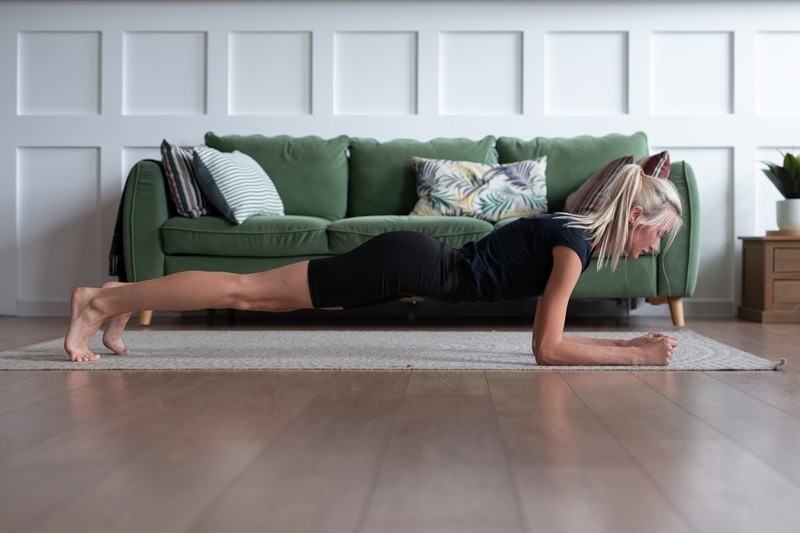
4. Forearm Plank with Scapular Retraction
“The plank with scapular retraction activates the deep core and shoulder blade stabilizers,” Zakhary explains. These muscles support a tall, stacked posture throughout the day.
The small, controlled shoulder blade movement trains the muscles that anchor the area without letting the upper shoulders take over. Avoid sinking your ribs toward the floor or shrugging your shoulders up toward your ears.
- Set up in a forearm plank with elbows under shoulders and body in a straight line from head to heels.
- Without bending your elbows, gently pull your shoulder blades together and slightly down toward your spine.
- Release back to neutral without rounding your upper back or letting your shoulder blades wing out. Keep your midsection braced and neck long.
- Move slowly and smoothly between those two positions for the duration of the set.
Try 2-3 sets of 20-30 seconds daily with smooth, controlled movements.
Featured Products


The post Simple Posture Exercises to Support Your Spine Every Day first appeared on The Upside by Vitacost.com.